
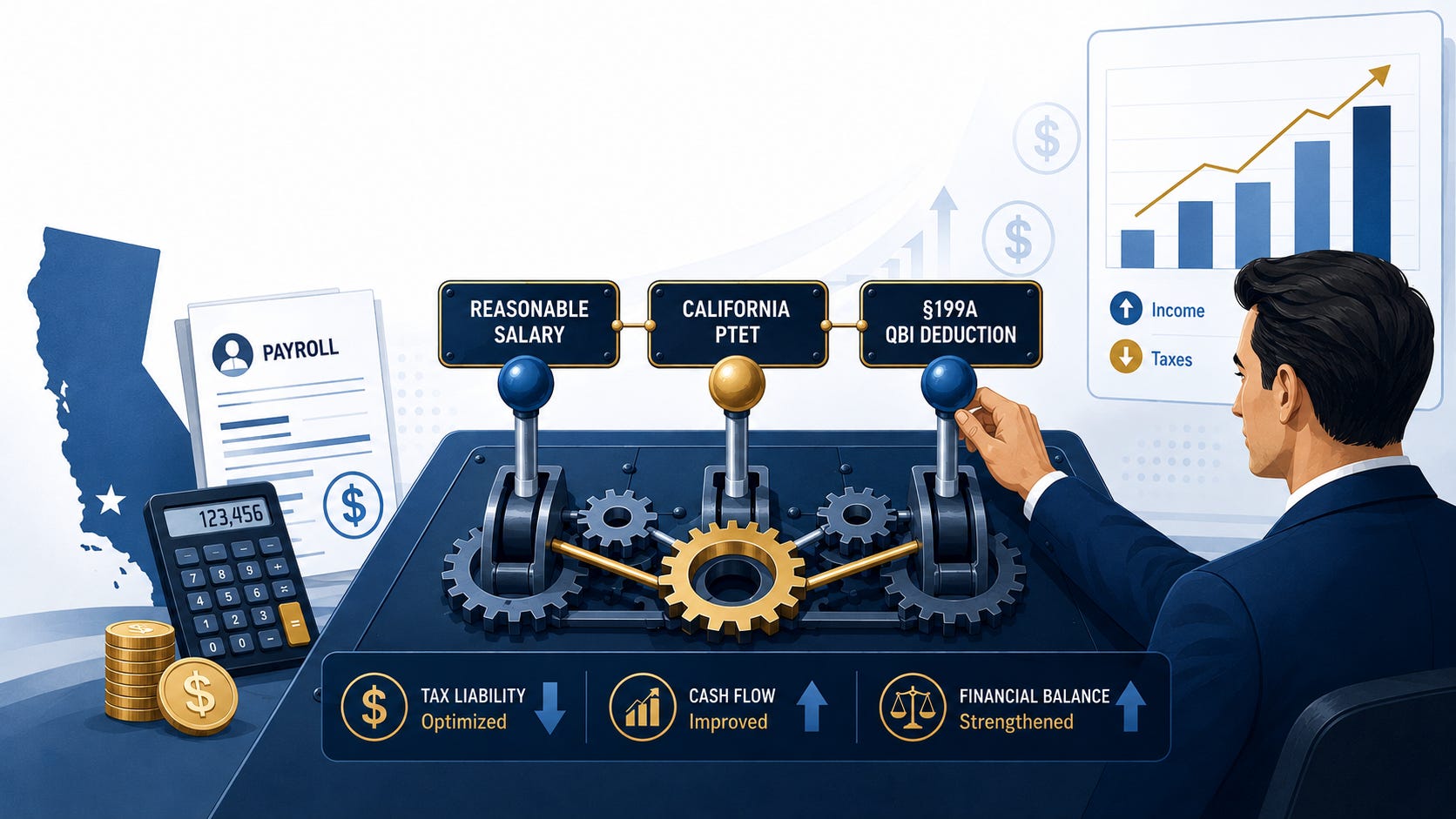
If you own an S corporation in California, you make three tax decisions every year that most owners treat as unrelated. These are how much salary to pay yourself, whether your entity elects into California’s pass-through entity tax (PTET), and how large a §199A qualified business income (QBI) deduction you end up with. These questions are highly interdependent. All three pull on the same dollars, and each decision shifts the correct choice for the other two.
Lever one: your salary
The law does not let you set your own salary freely. §162(a)(1) allows a deduction for “a reasonable allowance for salaries,” and the regulations measure that against what would ordinarily be paid for like services by like enterprises under like circumstances (Treas. Reg. §1.162-7). Pay yourself too little and take the rest as distributions, and the IRS can recharacterize those distributions as wages, with payroll tax, interest, and penalties attached. That is what happened in Watson v. United States (8th Cir. 2012), where an accountant’s $24,000 salary was reset to $91,044, and in Sean McAlary Ltd. v. Commissioner (T.C. Summ. Op. 2013-62), where a broker’s zero salary became $83,200.
The case law establishes that reasonable compensation is essentially the cost of replacing the work you actually perform, and it is not a fixed percentage of profit. The “60/40 rule” that circulates at networking events appears nowhere in the Code, the regulations, or any case law.
The §199A consequence is less widely understood. Reasonable compensation is expressly excluded from QBI (§199A(c)(4)), so every dollar you shift from distributions to salary is a dollar that leaves your QBI base. However, those same wages count toward the wage limitation that caps the deduction for higher-income owners. That is exactly what complicates the analysis. Salary is both shrinking the QBI base and raising the wage ceiling.
Lever two: the PTET election
The SALT deduction cap is the reason PTET exists. In Notice 2020-75, the IRS confirmed that state income taxes paid at the entity level are deductible by the entity and are not subject to the individual SALT cap. California’s answer is its elective pass-through entity tax. The entity pays 9.3% of qualified net income, and the consenting owner claims a matching credit on the California return.
Three California developments matter for 2026:
• The election survived. SB 132 extended it through the 2030 tax year. It had been scheduled to expire after 2025.
• June 15 is no longer fatal. Beginning with 2026, missing the June 15 prepayment no longer invalidates the election. Instead, each owner’s credit is reduced by 12.5% of that owner’s share of the shortfall. That is real relief to an all or nothing rule, but it is still a penalty.
• The credit is nonrefundable, with a five-year carryforward. If the flat 9.3% entity-level rate exceeds what you actually owe California on that income, you have prepaid tax you may not be able to use.
The federal cost is straightforward and easy to miss. PTET is deducted at the entity level, which reduces the ordinary income reported on your K-1, and that figure is where QBI begins. Elect PTET and your QBI falls by the full amount of the tax.
Lever three: the §199A deduction
The One Big Beautiful Bill Act made §199A permanent at 20%. For 2026, the taxable income threshold is $403,500 for joint filers and $201,750 for everyone else, with the phase-in ranges widened to $150,000 and $75,000 respectively (Rev. Proc. 2025-32).
Below the threshold, you take 20% of QBI with no further test. Above the threshold, the deduction is capped at the greater of 50% of a business's W-2 wages, or 25% of wages plus 2.5% of the unadjusted basis of qualified property. That cap phases in across the range and applies in full above it. Above the top of the phase-in range, a specified service trade or business (health, law, accounting, consulting, financial services, and similar fields) receives nothing at all, regardless of wages.
That wage cap is where all three levers collide.
Example
Assume a married couple filing jointly in California for 2026. One spouse owns 100% of a non-SSTB S corporation that earns $700,000 before owner compensation, pays $70,000 of wages to one other employee, and holds no meaningful depreciable property. They have $28,000 of mortgage interest and $14,000 of property tax, and no other income.
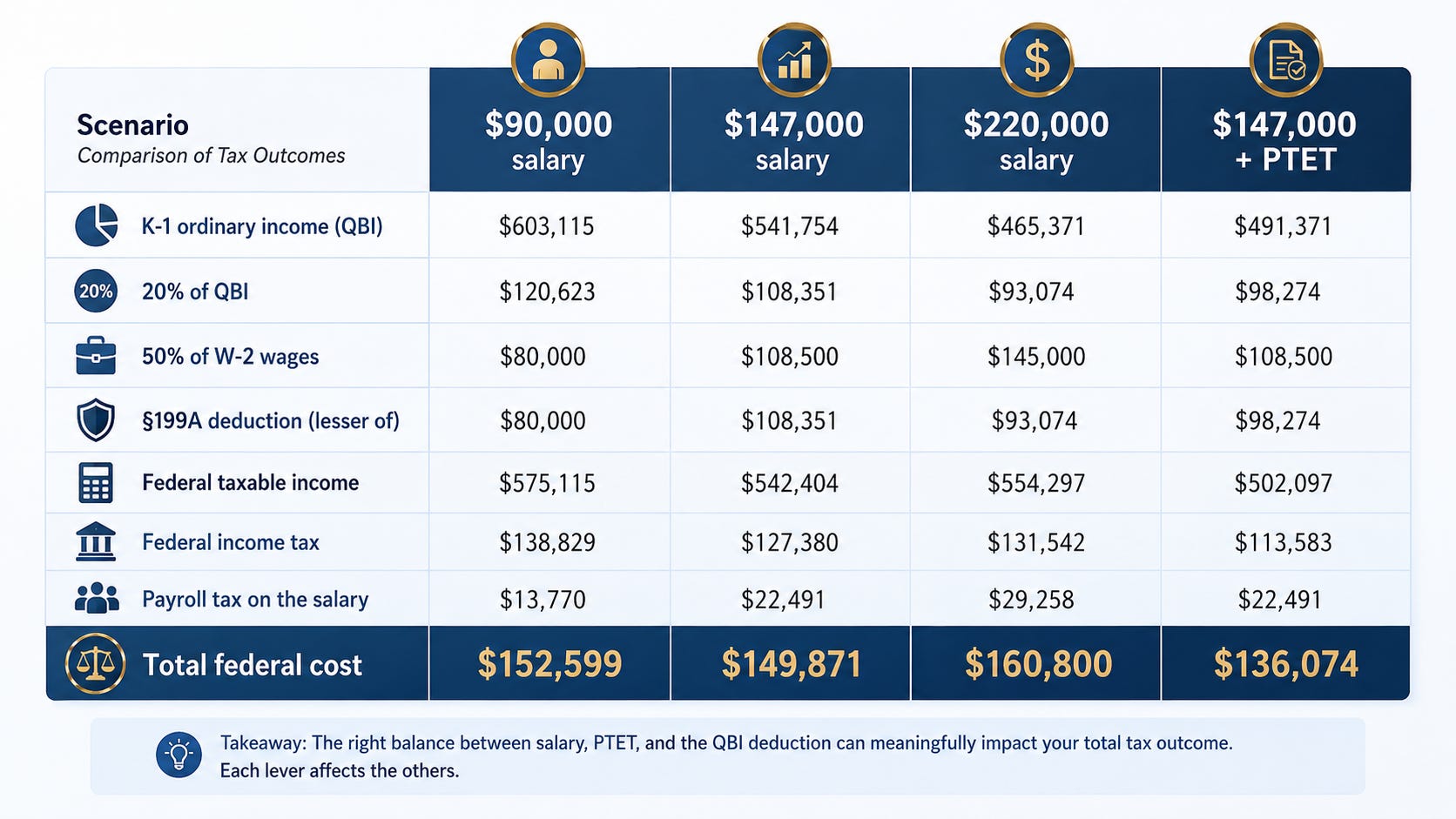
Illustrative only. Payroll tax includes both the employer and employee shares. California income tax, the 1.5% California S corporation tax, SDI, and state unemployment costs are excluded for clarity; including them does not change the direction of the results. At this income level the SALT deduction is fully phased down to the $10,000 floor in every column. The couple still itemizes and the new §68 limitation on itemized deductions does not yet apply.
The lowest salary was not the cheapest answer. At $90,000, the wage limitation caps the §199A deduction at $80,000. The owner gives up a $40,623 deduction to save $8,721 of payroll tax, and ends up roughly $2,700 worse off than at $147,000, while also holding the weakest position if the salary is ever examined. The aggressive number lost on the math before anyone raised the compliance question.
The PTET election moved the optimal salary. Without PTET, total federal cost in this fact pattern bottoms out near $147,000 of compensation. With PTET, the election reduces QBI, which lowers the 20% of QBI figure, which means the 50% of wages cap starts binding at a lower salary and the optimum salary falls to roughly $132,000. Set your salary in January and elect PTET in June, and you have optimized two decisions against each other.
When PTET does not pay
The election is not automatic. If your income is low enough that your state and property taxes already fit under the SALT cap of $40,400 for 2026, phasing down by 30% of modified AGI above $505,000 to a $10,000 floor (§164(b)(7)), then PTET converts a deduction you were already taking into an entity-level deduction, gains you nothing federally, and still reduces QBI.
A couple with $430,000 of AGI, $26,000 of California income tax, and $12,000 of property tax deducts the full $38,000 on Schedule A today. Elect PTET and their total deduction is unchanged, but QBI drops $26,000 and the §199A deduction drops $5,200, costing roughly $1,250 of additional federal tax. Add the possibility that the 9.3% credit outruns their actual California liability and the election looks worse still.
How to work the problem
The sequence matters more than any single rule of thumb:
1. Project taxable income first. It determines whether you are below the §199A threshold, inside the phase-in range, or fully limited, and those are three different problems.
2. Determine what will bind. If you are below the threshold, wages only subtract from QBI and the analysis favors the lowest defensible salary. If you are above it, wages create deduction capacity and the answer moves up. If you are an SSTB above the phase-in range, §199A is off the table entirely and the calculus changes again.
3. Set compensation on the merits, then test it. Support the number with the duties you actually perform and the hours you actually work. Perform a reasonable compensation study and create a written job description with contemporaneous notes. Then test the tax result at that level and at defensible amounts above and below it.
4. Test PTET at the chosen salary, then re-test the salary. The two interact, so one pass is not enough.
5. Calendar the deadlines. Compensation is set through payroll across the whole year and is difficult to fix in December. The California prepayment is due June 15, and while a shortfall no longer voids the 2026 election, it still costs 12.5% of the underpayment in credit.
The takeaway
None of this yields a rule you can carry in your head. The interaction between reasonable compensation, the PTET election, and §199A is genuinely circular. Each lever moves taxable income, and taxable income determines which set of §199A rules applies to you. That is precisely why it rewards a projection rather than a rule of thumb, and why the work belongs in the first half of the year rather than the week before the return is due.
The good news is that the numbers are knowable. Every figure in the example above came out of a projection that any competent preparer can run before you commit to a salary or a June 15 payment. The owners who lose money on this are rarely the ones who made a bad decision. They are the ones who made three good decisions separately.